Social Learning Platform Analysis
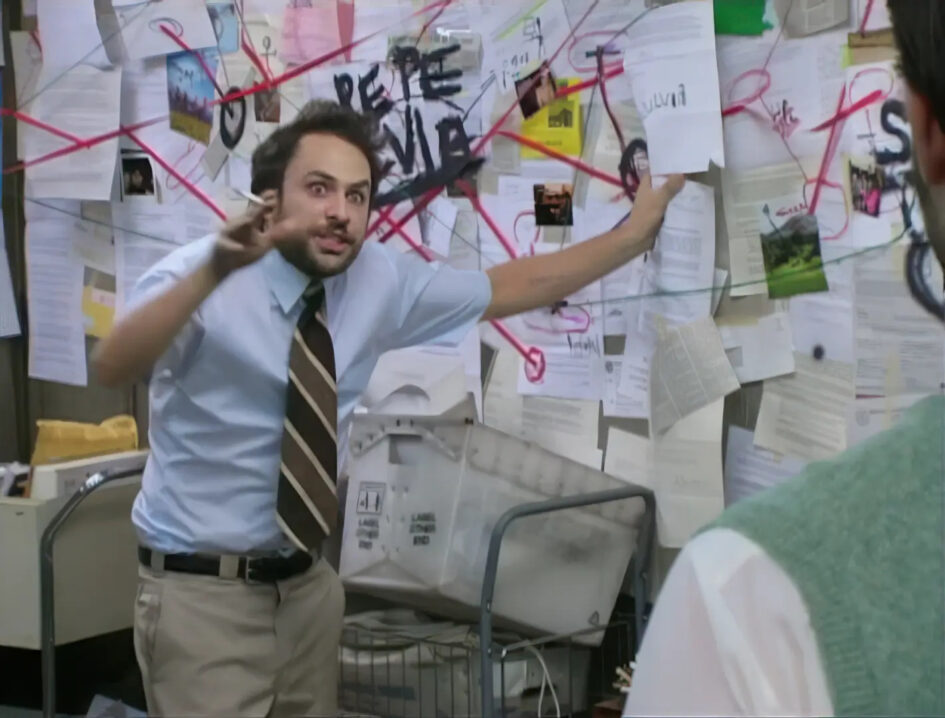
Pepe Silvia meme (2008, It’s Always Sunny in Philadelphia) *A frantic man, a wall of string and photos, every item connected to the other*
Platform Choice & Justification
I thought this meme (used in the outline of the social learning platform) perfectly captures how I feel when I use TikTok. I constantly have a million different thoughts and, most of the time, do not have the attention span to even watch the entire video that I am viewing. I think of another idea related to the video, search up whatever triggered that thought, reply to a friend, and before I know it, I’ve spent an hour on the app and can barely recall what I watched. Used carelessly, TikTok can negatively impact learning, but used intentionally, it can have a positive impact! TikTok is a social learning platform because people create, share, and discuss knowledge. Creators explain ideas and offer advice, and viewers respond by commenting, liking, sharing, and dueting. Duets make TikTok more interactive by letting you record your own video over another creator’s. This turns a single video into a conversation; you can build on each other’s ideas and comment back and forth.
I wanted to explore TikTok as a social learning platform because I use it informally to learn recipes, research opinions on clothes or places, and a variety of other things. I realized I haven’t looked further at how it shapes what I learn, the platform’s algorithms, and how to make it a successful learning tool. This analysis will allow me to learn how I can use TikTok as an effective tool rather than just scrolling passively for entertainment.
Analytical Framework
The questions I will be asking to evaluate TikTok will be:
- Can learners build a network that supports ongoing learning? – PLN (Gutierrez, 2016)
- What does TikTok make easy, hard, or expected? – Affordances (Bucher & Helmond, 2018)
- What does the platform decide for the learner? – Cognitive Offloading (Risko & Gilbert, 2016)
- Who is this platform safe and accessible for? – Diversity and inclusion (Moore & Schnellert, 2016)
- Can learners tell what is true? – Information quality (Wardle & Derakhshan, 2017)
These course concepts look at whether learning occurs on TikTok but also look at how the way the platform is designed shapes who learns, the content they learn, and who is in control.
Platform Analysis
Personal learning network:
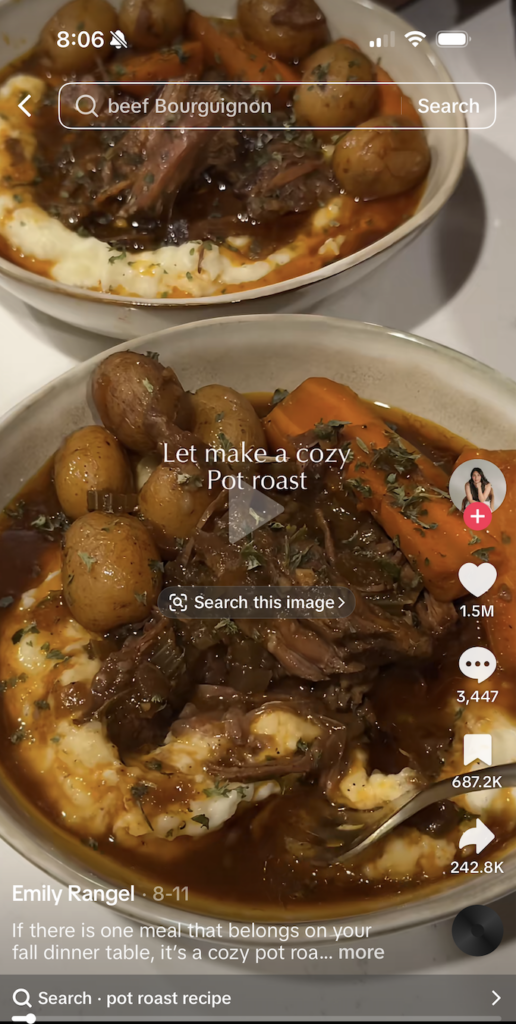
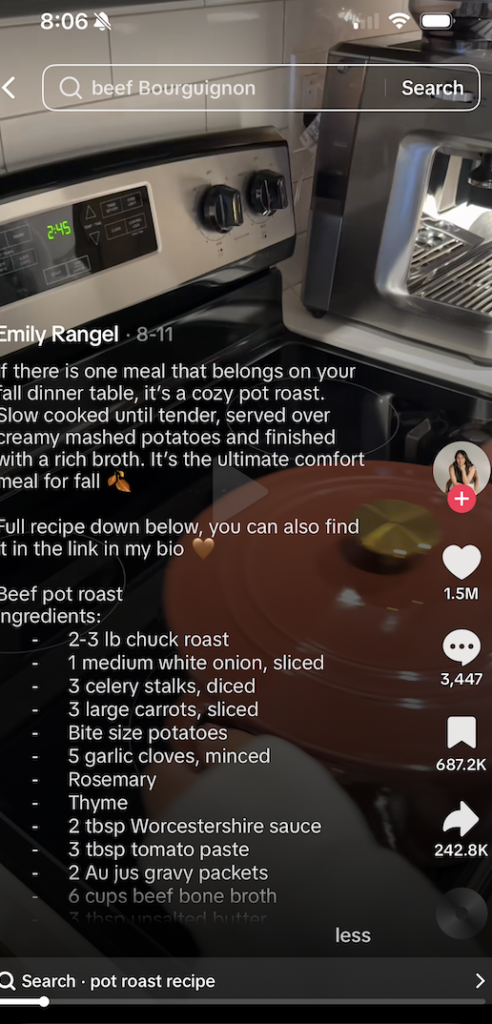
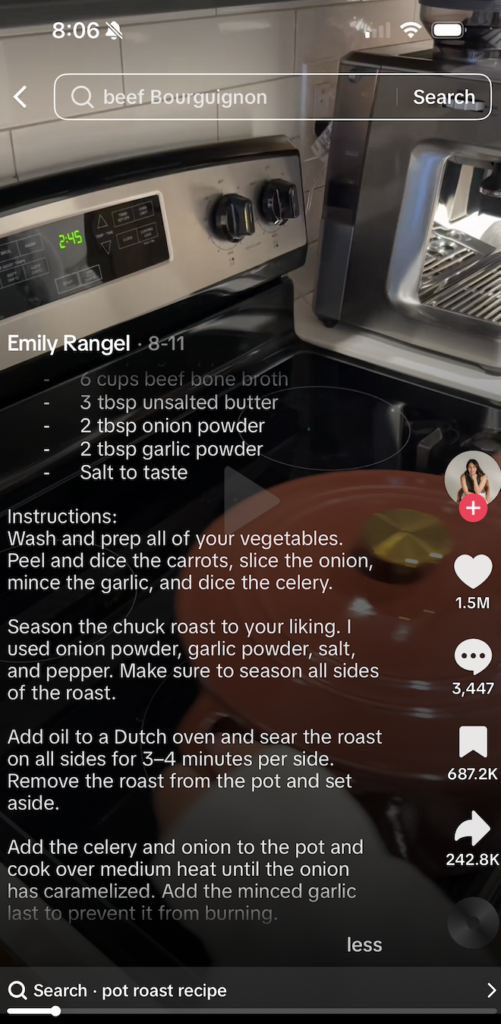
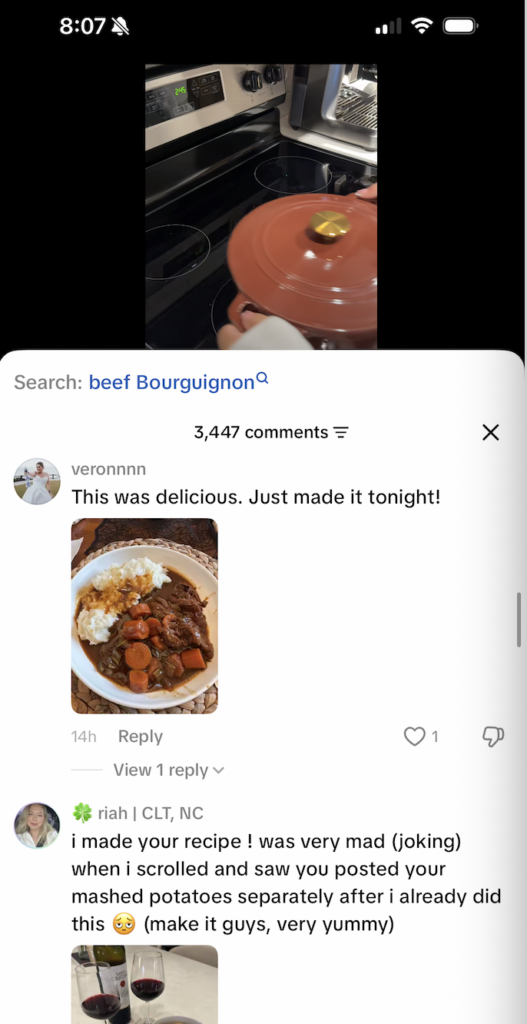
Gutierrez (2016) describes a PLN as a web of connections that supports continuous learning through shared resources and conversation. I chose to focus on a niche so that I could investigate this further. The niche that I chose to explore is cooking videos. Cooking is a practical skill that people learn by watching, trying, and asking questions. After looking at a few different creators, my feed was saturated with cooking videos. In @EmilyRangel’s video (please see the 4 attached screenshots below), the creator shows physically what the end product of the dish is, lists the ingredients, and shows every step. In the comments, you see people sharing their own results, and additional conversation from these images occurred, which included people sharing their own experience, what they would do differently next time, or just how much they like the recipe. This aligns with Gutierrez’s concept of shared resources and conversation. One downside is that, because of the algorithm, my feed becomes saturated after I interact with just a single video from a random creator. Comment threads also get lost easily, so a question about a recipe may never get answered. TikTok is good at exposing me to cooking knowledge rather than a sustainable learning environment; a PLN needs a sustainable environment to support continuous learning.
Affordances:
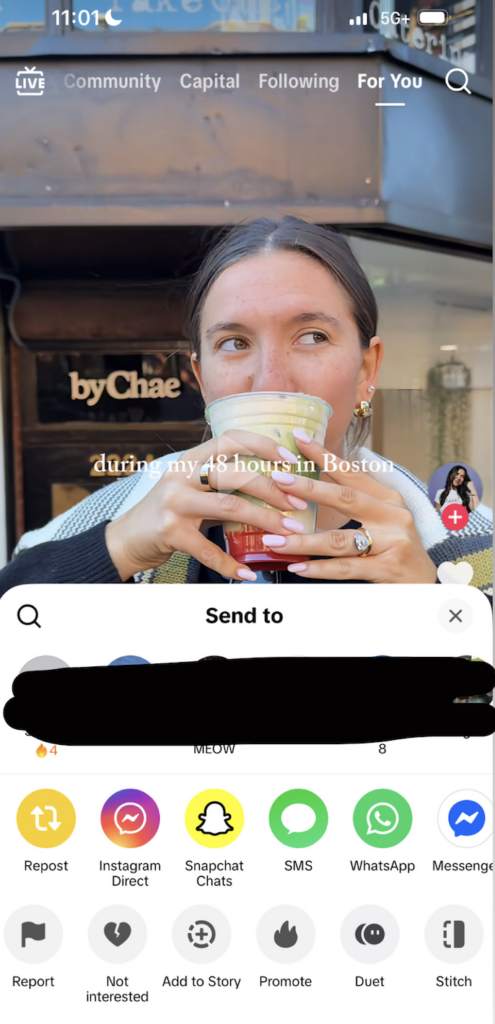
Bucher and Helmond (2018) explain that affordances come from both a platform’s design and how users perceive it. TikTok’s design makes scrolling the easiest choice; videos will autoplay and loop, and the next video is directly below with only one swipe. The design prioritizes exposure over retention. I can save, share, or duet a video; these tools encourage interaction, but they don’t inspire me to study a topic in depth. TikTok’s design makes it hard to dive deep into topics, and finding a video I watched earlier takes deliberate effort. The design expects me to keep scrolling and not dive deep into any topics to learn further. The screenshot attached below shows the options that appear when I press ‘share’ (the users are blacked out for privacy).
Cognitive Offloading:
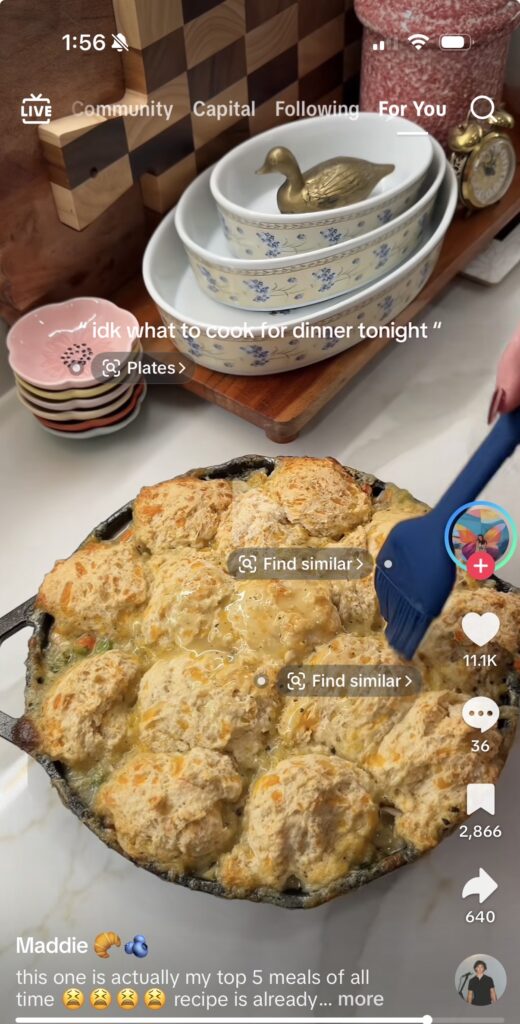
Risko and Gilbert (2016) explain cognitive offloading as using a tool to reduce mental effort. The For You Page offloads two things: deciding what to learn next and what deserves attention. For example, when I searched for cooking videos, multiple different cooking videos followed shortly after. It is helpful that these came up after watching one related video. The platform decides what learners see next based on their previous interactions. A downside of this is that I stop making these choices myself, leading to hours of pointless scrolling. After scrolling for a bit, I could barely recall any specific information about the videos; I could give some topics of what I watched, but almost nothing further. Attached below is a screenshot of another suggested cooking video from when I was scrolling on my FYP.
Diversity and Inclusion:
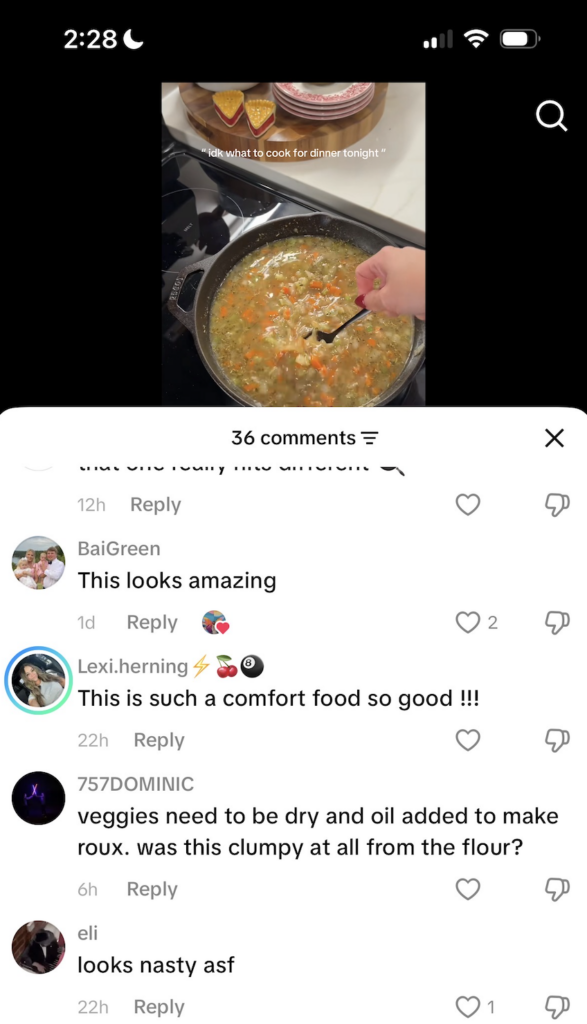
Moore and Schnellert (2016) explore how diversity and inclusion work together in education. Inclusion goes past just letting anyone join the platform; it means designing the platform so that a range of learners can access it and participate. Anyone can sign up for the app and use it, but that does not mean it is inclusive. Negative comments can easily arise, and duetting, commenting, liking, and sharing can add to hateful topics that can come up. TikTok has features that can filter rude words and has ‘creator care mode,’ which is a filter that catches inappropriate comments. However, it ultimately falls on the user to protect themselves. Trending quick snippet videos can be hard for learners with disabilities and for English language learners. For English language learners, fast-paced videos are harder to follow when captions are missing, or transcripts are not offered. Using TikTok also requires a phone and data; it works on a laptop, but with fewer features. Below is a screenshot of a hate comment on a video with only 36 comments, so a video with thousands of comments could easily contain way more.
Information quality:
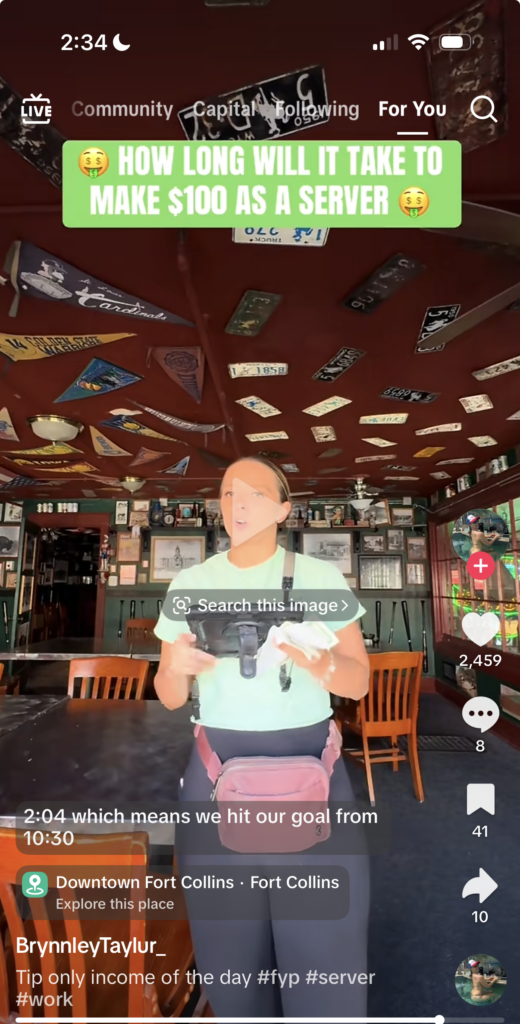
Wardle and Derakhshan (2017) analyze information through the person who creates it, what is communicated, and how the information is perceived. On TikTok, the person who creates it can be unclear because if a video is engaging, it can look like this person has ownership over the video even if there is no credit to the original creator. Short videos make it easier to believe claims without evidence. They also leave little time to reflect on what I’m viewing mid-scroll. The algorithm adds to this by suggesting more of what I have previously interacted with, which limits what I see. The screenshot below showcases a restaurant server, and she is challenging herself to see how much she can earn in a set time. I am a server, and when I am watching this video, questions that go through my head are about comparing my earnings to hers. I had not considered the tables she was assigned or the area she lives in, yet these factors strongly affect how much she ultimately makes. This shows that when a video is engaging, I do not question the context.
Reflections & Implications
My analysis shows that TikTok is a great platform to discover different topics, but the depth is weak. As a user, I noticed how the algorithm is designed to make it extremely easy to scroll passively by default. I can use TikTok more intentionally by following specific educational creators (e.g., cooking creators that have gone to culinary school or psychologists with PhDs) and by searching topics instead of defaulting to scrolling on my FYP. Learners who benefit the most are those who have limited time available, are visual learners, and get overwhelmed easily by formal websites such as Google Scholar. Being able to consistently evaluate the content they are consuming is crucial, as the app focuses on engagement rather than accuracy. This applies to any algorithm-driven platform like Instagram; the feed, not the user, decides what is shown to them. For example, we can use TikTok to get a general idea of a topic and build on it after we get a simple understanding with more reliable sources like Google Scholar.
References
Bucher, T., & Helmond, A. (2018). The affordances of social media platforms. In J. Burgess, A. Marwick, & T. Poell, The SAGE handbook of social media (pp. 233-253). SAGE Publications. https://doi.org/10.4135/9781473984066.n14
Gutierrez, K. (2016). What are personal learning networks? Shift eLearning. https://www.shiftelearning.com/blog/personal-learning-networks
Moore, S., & Schnellert, L. (2016). One without the other: Stories of unity through diversity and inclusion. Portage & Main Press. https://ebookcentral.proquest.com/lib/uvic/reader.action?docID=4832579&ppg=11&c=RVBVQg
Risko, E. F., & Gilbert, S. J. (2016). Cognitive offloading. Trends in Cognitive Sciences, 20(9), 676-688. https://doi.org/10.1016/j.tics.2016.07.002
Wardle, C., & Derakhshan, H. (2017). Information disorder: Toward an interdisciplinary framework for research and policymaking. Council of Europe. https://rm.coe.int/information-disorder-toward-an-interdisciplinary-framework-for-researc/168076277c